Skip to content
The Texas A&M University System Center for Applied Communications and Networks Logo
  • Home
  • About
  • Tracks
  • Venue
  • Schedule
  • Register
  • Sponsor
The Texas A&M University System Center for Applied Communications and Networks Logo
  • Interop 2026
  • About
  • Tracks
  • Venue
  • Schedule
  • Register
  • Sponsor
  • CACN Home

the conference tracks reflect the most pressing challenges and innovatoins in the field.

Expert‑designed tracks tackling today’s most urgent interoperability needs.

The Interop 2026 conference is organized around strategic learning tracks shaped by the Interop Steering Committee—a multidisciplinary group composed of academic experts, Texas A&M System partner agencies, as well as representatives from state, federal, and local agencies.

These tracks focus the conference experience—aligning presentations, demos, and training around the skills and solutions professionals need now to advance interoperability across the public sector.

Together, these leaders bring a broad perspective on emerging challenges in communications, networking, operations, and public‑sector interoperability.

Drawing on their collective expertise, the Steering Committee identifies the most urgent needs across higher education and government environments and designs focused tracks that deliver relevant, actionable learning experiences. This structure ensures that every session—keynotes, presentations, workshops, and demonstrations—is aligned with real‑world demands and supports meaningful, sustainable interoperability across Texas A&M and its partner institutions and agencies.
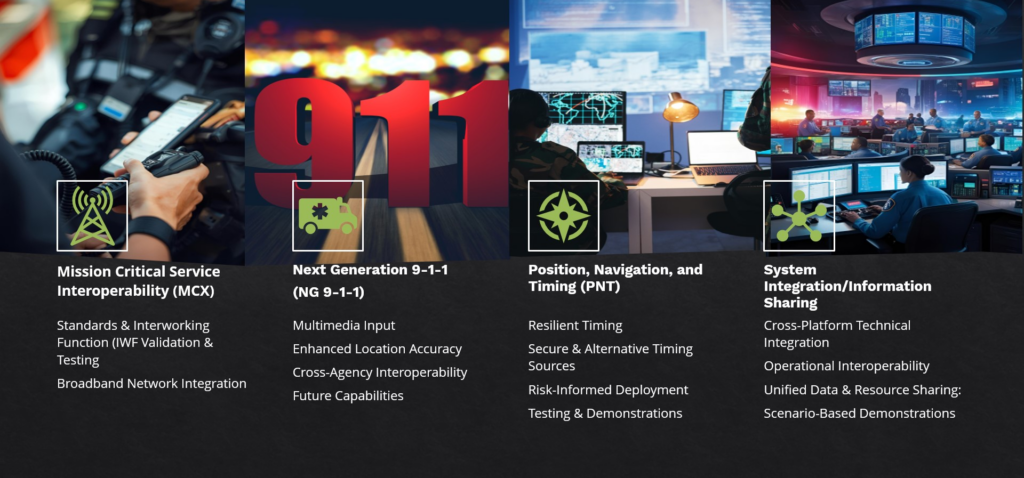
Interop 2026 Conference Tracks

This track focuses on Mission Critical Services (MCX) and P25 networks interoperating across 4G LTE and 5G broadband networks, both public service providers and private networks, satellite and Sidelink to support highly resilient and secure public safety communications. This track focuses on what’s needed for MCX services to work across service providers and diverse vendor solutions.​
​
KEY CONCEPTS

Standards & Interworking Function (IWF): MCX systems behave predictably across service providers and vendor platforms.​

Validation & Testing: Multi-service / multi-vendor interoperability testing to confirm conformance and interoperability.​

Broadband Network Integration: Leveraging LTE/5G, Public/Private networks, satellite and Sidelink to enhance reliability, coverage, and service quality for critical communications.​

Next Generation 9-1-1 (NG9-1-1 replaces legacy analog 911 systems with a digital, IP-based infrastructure capable of advanced data sharing, multimedia intake, and cross‑center collaboration.​
​
Implementation Status​
The transition is underway across North America, with Canada’s rollout expected to reach completion in March 2027. Many U.S. jurisdictions are at various stages of migration and operational testing.​
​
Key Features​
Multimedia Input: Text, images, and video to PSAPs for more complete incident awareness.​
Enhanced Location Accuracy: More precise caller data supporting faster, safer response.​
Cross‑Agency Interoperability: Seamless exchange of data between PSAPs, ECCs, EMS, law enforcement, and other responders.​

PNT resiliency is central to the operation of cellular networks, energy infrastructure, military systems, and modern digital platforms—all of which depend on accurate time standards, historically provided by GPS.​
​
Key Priorities​
Resilient Timing: Maintaining accurate time even when GPS is degraded or unavailable.​
Secure & Alternative Timing Sources: Reducing dependency on GPS as a single point of failure.​
Risk‑Informed Deployment: Encouraging organizations to assess vulnerabilities and plan for resilient PNT operations.​
Testing & Demonstrations: Building scalable reference systems that can be evaluated and stress‑tested in realistic environments.​
​
As reliance on GPS continues to grow, resilient PNT becomes a national security and critical-infrastructure priority.​

This track focuses on the operational side of interoperability—ensuring that technology, networks, workflows, and agenciesfunction cohesively in real‑world environments.​
​
Core Focus Areas​
Cross‑Platform Technical Integration: Aligning systemsfrom different vendors or agencies so they operateseamlessly together.​
Operational Interoperability: Improving agency‑to‑agencycommunication across public safety, research institutions,emergency management, and infrastructure operators.​
Unified Data & Resource Sharing: Connecting digitalplatforms, radio systems, broadband networks, and missionsystems into coordinated workflows.​
Scenario‑Based Demonstrations: Live testing, exercises,and multi‑agency collaboration models that showcasepractical interoperability.​
​
Together, these elements form the foundation for robust,scalable MCX interoperability essential to first responders andcritical infrastructure operators.​

Why Interop Matters

Interop 2024 Video

Discover the real impact of the Interop Institute through the voices of those who make it possible. This video brings together candid insights from sponsors, industry leaders, and attendees as they share how Interop creates unmatched value—from accelerating technology adoption to forging collaborative partnerships that strengthen first responder communications.

Hear firsthand how the event’s hands‑on demonstrations, cross‑sector engagement, and problem‑solving environment empower innovators, agencies, and solution providers to work together in new and meaningful ways. If you’re considering attending, sponsoring, or engaging with the Interop Institute, this is the clearest window into why this gathering has become a cornerstone for advancing interoperability across the nation.

Watch the conversations shaping the future of emergency communications.


Thank you to our Sponsors!

The CACN Team sincerely thanks our Interop Institute sponsors for your support and partnership. Your commitment helps make Interop a collaborative, hands‑on environment where innovation, interoperability, and mission‑critical communications advance together. We are grateful for your continued engagement and leadership in this community.


Learn more about sponsoring Interop

reveille


howdy


Lanyard

Synderys Logo

CORPs

CACN logo

Physical Address:

1255 Bryan Rd

Ste 219

Bryan, TX 77807

View on Google Maps

Parking:

Use the ParkMobile App, Zone 7743

Contact Us

State of Texas
Texas A&M University System
TAMUS Office of Research

Privacy
State Link Policy
Accessibility
Risk, Fraud & Misconduct Hotline

Log in

© Center for Applied Communications and Networks - All Rights Reserved

YouTube Linkedin
Scroll to top